




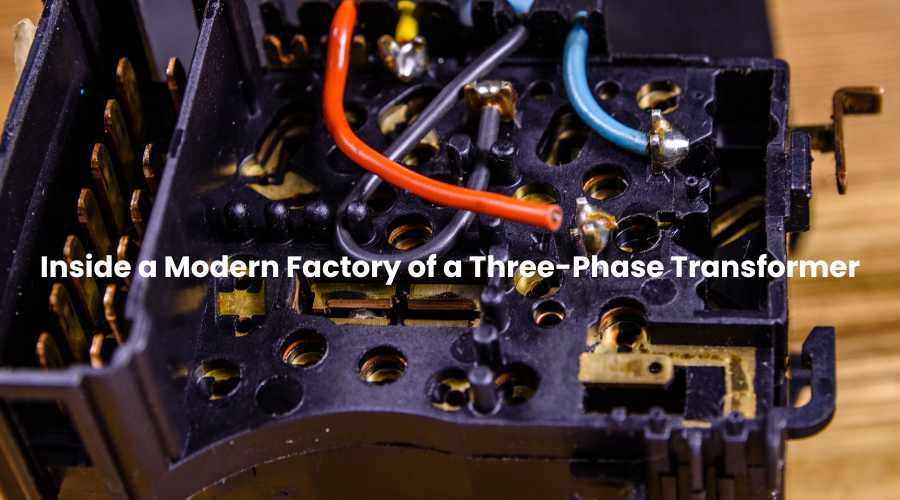
Transformers are everywhere. They are installed on utility poles, on walls, and in buildings. They control the electric current that serves residences, offices, and industries. A three-phase transformer is one of the most commonly produced kinds of transformers. It is used in home power supplies, small commercial installations, and a wide range of industrial equipment.
But what is the construction of a three-phase transformer? What goes on in the factory until such a completed unit is shipped out? This blog will discuss the complete manufacturing process in simple terms.
A three-phase transformer is a device that transmits the electric power between two circuits through electromagnetic induction. It is made up of two coils: one is the primary, and the other is the secondary winding, and is enclosed by a magnetic core. Voltage goes in through the primary winding. It is emitted at another voltage level on the secondary winding.
The turns ratio of the two windings determines whether the transformer step is up or down. This simple but powerful principle is at the heart of every three phase transformer made in any factory in the world.
Raw materials are procured and checked before production begins. These materials greatly influence the quality of the finished transformer and its service life.
The center consists of silicon steel laminations. The magnetic losses made by silicon steel are low. It enables the magnetic field to be transmitted through it without producing a lot of heat. The laminations do not form a three solid block; rather, they are stacked into thin sheets. This design minimizes the energy lost by the flow of electrical current through the core's circulatory area.
The most common wire is copper. It has lower electrical resistance and generates less heat during operation. Aluminum is nearly lighter and less expensive, yet it requires bigger conductor cross-sections to compete with copper. There must also be insulating materials. These are insulating paper, varnish, resin, and pressboard. They render the windings and the core isolated.
The manufacturing process starts with the core. Silicon steel is delivered to the factory as large coils or already cut sheets. These sheets are first cut to exactly the size needed to fit the transformer design.
Cutting and Stamping
Automated cutting machines cut silicon steel into strips, then stamp the strips into designated shapes. The shapes of the most common ones are E-, I-, L-, or T-shapes, depending on the core design. Accuracy is important in this case. Minimal dimensional variations affect magnetic performance.
The Surface Treatment and Deburring.
The laminations cut are deburred after cutting. Rough surfaces and sharp edges are energy losses, causing damage to insulation. A thin insulating coating is then applied onto the laminations. This coating avoids the transfer of electrical current between individual sheets when they are piled one on top of the other.
Stacking the Core
The laminations are stacked in a specific pattern. Switching the direction of every layer decreases vacuity in the core. Air gaps augment magnetic resistance and efficiency. The laminations are stacked and aligned under controlled conditions by workers or automated systems.
Now that the core is ready, the windings will be produced. It is among the most accurate processes of transformer production.
Selection and Preparation of Wires.
It has to do with choosing the right wire gauge, depending on the transformer's voltage and current ratings. High-voltage, low-current windings are made using thinner wire. The wire is supplied with a thin layer of enamel insulation.
Winding Process
The wire is then wound around a former, which is a molded frame that provides the structure of the coil. The number of rotations that are wound on the former is counted and monitored. It is a number that establishes the transformer's voltage ratio. An excessive number of or a deficiency in turns modulates the output voltage.
An insulating layer wrapping is added between the winding layers. This also avoids short-circuiting between layers that touch each other. A continuous tension on the wire does this. Inequality tension forms loose coils that may move during operation, damaging it.
Primary and Secondary Windings.
The primary and secondary windings are fabricated individually. In other designs, they are concentrically wound one over and around the other on the same core limb. In other designs, they are installed side by side along the various limbs of the core.
After the windings and the core are ready, they are assembled. The windings are attached to the core. There are insulation barriers between the windings and between the windings and the core surface.
This is followed by clamping and fixing of the assembly. The core laminations are clamped together. A narrow center minimizes vibration during operation.
The insulation treatment is one of the essential steps that heavily impact the reliability of the transformer, as well as its life.
Varnish Impregnation
The complete unit, consisting of a core and coil, is placed in a vacuum chamber. Under vacuum, air and moisture are expelled. The addition of liquid varnish or resin follows it. It reaches deep into the windings, filling every opening and pore. The unit is then cured in an oven. The varnish dries and forms a solid, closed shell.
This ensures the windings are certain not to get wet, dusty, or vibrate. It also enhances the heat dissipation of the coils during operation.
The core and coils assembly has been treated and placed into its enclosure. This can be an open frame, a vented metal casing, or a sealed weatherproof housing, depending on the intended use.
Terminal connections are installed and fixed. These are the points of connection where the transformer is attached to the electrical circuit. There are labels and rating plates attached. These depict the voltage rating, frequency, power capacity, and others.
No transformer leaves the factory without undergoing a set of electrical tests.
Routine Tests
All units are subject to regular testing. This has a turns ratio test to ensure that the output voltage is as per design. A high-voltage test is performed to ensure the insulation can withstand voltages exceeding normal operating levels. A load test is to ensure that the transformer is working as intended when subjected to its rated current.
Additional Checks
Physical inspection reveals no defects. Temperature rise tests ensure that the transformer does not overheat under full-load conditions. Insulation resistance tests measure the quality of the insulation on the windings and between windings and the core. All units that pass the tests are accepted for shipment.
The production of a three-phase transformer is a multi-stage process that is highly accurate, and at each stage, the product's outcome is influenced. This knowledge can guide the buyers, engineers, and procurement teams in making a better buying choice when they are sourcing transformers to power their projects.
Transformers are everywhere. They are installed on utility poles, on walls, and in buildings. The
READ FULLImagine a city's water system. High pressure moves water across miles of pipe. Low pressure deliv
READ FULLThe kVA rating is one of the earliest numbers that is used when purchasing or ordering a single-p
READ FULL