




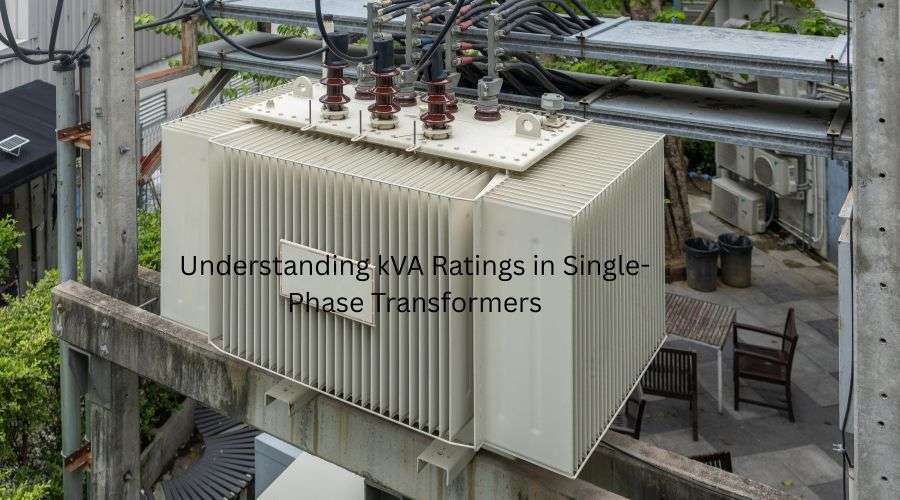
The kVA rating is one of the earliest numbers that is used when purchasing or ordering a single-phase transformer. This number can be confusing to many people. What does kVA actually mean? How is it different from kilowatts? And what is the sense in it when deciding on a transformer?
KVA ratings are not as difficult to understand as they may appear. Once the basic concept is understood, selecting the correct transformer for any application becomes all the easier. The article explains the kVA rating, covering what it is and its practical use in selecting a single-phase transformer.
kVA is short for kilovolt amperes. It is a unit of measurement of apparent power in a system of electricity. The kilo part means a thousand. Therefore, 1 kVA is equivalent to 1,000 volt-amperes.
To know how this will work in practice, we had better divide it further. Electrical pressure, which propels current through a circuit, is called Voltage. Ampere or amps are used to quantify the movement of electric current. When current is multiplied by voltage, the figure obtained is a measure of electrical power.
The reason is that it has two different measures.
Among the most confusing points regarding the kVA is the apparent and real power. Actual power is quantified in kilowatts -kW. It gives the real power that the load uses to work. Apparent power is measured in kVA. It is the sum of the power that the transformer needs to deal with, the useful power, and the reactive power.
Reactive power can be found in circuits containing inductive or capacitive elements, such as systems, motors, transformers, fluorescent lighting ballasts, and variable speed drives. These parts attract current that is not necessarily used in useful work, yet the current remains in the machine. This current has to be processed by the transformer with the actual power current.
The relationship between kVA and kW is known as the power factor. Power factor is a ratio ranging from zero to one. It is a measure of the efficiency of converting electrical current into useful work.
A purely random load, such as an electric heater or an incandescent light bulb, has a voltage factor of one. In this instance, kVA and kW are the same. Power factor of a typical motor or other load inductively consumed is 0.7 to 0.9. It implies that the transformer must deliver more apparent power than the useful power utilised by the load.
That is why transformers are not rated in kW but in kVA. The power factor of the load connected to the transformer will not be known to the transformer. It is nothing more than that which carries current. The transformer is rated in kVA to accommodate the entire electrical requirement, even at non-unity power factors.
Transformer to the Load Matching.
Selecting a transformer of the proper kVA rating is among the steps that can be defined as the most significant ones during any electrical installation. A small transformer will overheat under load. The breakdown of the insulation, its short life, and overheating-related failure. An oversized transformer will work hard, but it will be an unnecessary use of resources.
The aim is to choose a transformer with a kVA rating large enough to accommodate all loads connected to it with ease, leaving some additional capacity. This margin takes into consideration future increases in load and starting surges by the motors and other inductive equipment, which release more current when initially operated.
The calculation of the required KVA
The sum of the load current and the supply voltage must be known to calculate the kVA required for a given application. In a single-phase system, the calculation is not complicated.
kVA required = (voltage x total load current)/1000
In case of specifying the loads in watts or kilowatts instead of current, the power factor has to be used to convert the real power to the apparent power.
kVA required = total kW/Power Factor.
Common Sizes Available
Single-phase transformers are produced in standard kVA ratings of various power types. Other large single-phase transformers can be found with selected high-power applications.
The standard sizes are available because they meet common load requirements in residential, commercial, and industrial applications. A calculated requirement between two standard sizes will always be used to fine-tune the selection of the larger size to ensure sufficient capacity.
Custom Ratings
Specialized applications, Transformers may be made to custom kVA ratings. This would occur in industrial settings where unusual power input is required for process equipment. Custom sizes are costlier than standard sizes, and the lead time is extended. Making everything as standard as possible is usually more feasible and economical.
The Impact of Heat on Transformer Operating.
The amount of load a transformer can safely bear depends directly on temperature. All the transformers produce heat as a by-product. All the windings, core, and insulation are heated in operation. The kVA rating that appears on the nameplate is calculated at an ambient temperature that is within a specified range - normally 40 degrees Celsius.
A downside of this design style is that, at physical temperatures above this limit, a given transformer cannot safely operate at its full rated kVA. The thermal load, caused by the load, contributes to the already high ambient temperature. This may overstrain the transformer's internal temperature. This is a real concern in hot or poorly ventilated sites for installing the transformers, and should be taken into consideration when selecting a transformer.
High Temperature Derating.
In situations where a transformer must operate at high ambient temperature, derating is applied. Derating involves using a larger transformer than is necessary to power the load. The added capacity provides headroom in addition to the heat stress from the high ambient temperature.
The manufacturer usually provides derating tables. Those tables show how the usable kVA capacity decreases with ambient temperature. These guidelines will make sure that the transformer used is safe to operate and can attain the expected service life even during difficult thermal conditions.
How Losses Relate to kVA
Any transformer suffers losses when operating. These losses are of two categories. Core losses, known as iron losses, are continuous and occur whenever the transformer is energized, even with no load. Copper losses, also known as winding losses, rise with the load. These losses, combined, define the transformer's efficiency.
A transformer with lower operating kVA than its rated operating kVA will also have less winding losses, but the core losses will be constant. This implies that even lightly loaded transformers may be quite inefficient, since core losses are constant and account for a higher percentage of the total power. Running a transformer between 50 and 80 percent of its rated kVA is usually regarded as the most efficient operating range for most designs.
Productivity and Variable Costs
In the case of continuously-operating transformers, such as distribution transformers or permanent industrial installations, efficiency directly impacts running costs. A more efficient transformer dissipates less heat. With years of uninterrupted operation, even a minor efficiency gain will translate into significant savings in the energy expenses. Efficiency at the anticipated operating load level is a consideration when choosing between different models and manufacturers of transformers for permanent installations.
One of the most significant specifications to understand when choosing, installing, or repairing electrical equipment is the kVA rating of a single-phase transformer. It is the sum of all apparent power that the transformer can deliver safely and continuously under specified conditions. The correct approach to obtaining the kVA rating initially ensures quality performance, improved service, and safe electrical installations overall.
Transformers are everywhere. They are installed on utility poles, on walls, and in buildings. The
READ FULLImagine a city's water system. High pressure moves water across miles of pipe. Low pressure deliv
READ FULLThe kVA rating is one of the earliest numbers that is used when purchasing or ordering a single-p
READ FULL